

Rijkswaterstaat makes safety an integral part of its largest-ever infrastructure renewal programme
The Netherlands is facing the largest infrastructure renewal programme in its history. Bridges, tunnels, locks and viaducts built in the 1960s and 1970s are reaching the end of their service life on a large scale, while road and waterway traffic must continue to flow as smoothly as possible. At the same time, maintenance budgets are under pressure and projects are becoming increasingly complex.
This is precisely why Rijkswaterstaat is fundamentally changing the way safety is organised. Rather than treating it as a separate theme or a final compliance check, safety is becoming a guiding principle throughout design, asset management, project delivery and collaboration with the market. At Safety&Health@Work, Safety Programme Director Nienke Bagchus and Strategic Safety Adviser Anton van Opzeeland will provide an insight into this transformation.
From fragmentation to central coordination
According to Bagchus, safety has always been high on Rijkswaterstaat’s agenda. After all, "safe, liveable and accessible” has formed the core of the organisation for many years. In practice, however, responsibility for safety was highly fragmented.
"Our Director-General should be able to ask one simple question: what is the current state of safety within Rijkswaterstaat? You need to be able to provide one clear answer. That requires an organisation in which all knowledge, monitoring and decision-making come together.”
Rijkswaterstaat is therefore bringing safety specialists, research capabilities and monitoring activities together within one central organisation. A Safety Board, chaired by the Director-General, will also be established. Its role will not only be to provide advice, but also to actively direct and manage safety-related issues.
Three responsibilities, one safety vision
Rijkswaterstaat’s challenge extends beyond ensuring safety on construction sites alone. "We essentially have three duties of care,” Van Opzeeland explains. "We are an employer, an infrastructure manager and a client.”
This means that Rijkswaterstaat is simultaneously responsible for safe working conditions for its own employees, safe infrastructure for road and waterway users, and the safe delivery of work by contractors.
"In the past, these three areas were not sufficiently connected. By considering them as a whole, we gain a much clearer understanding of both the risks and the measures required.”
Safety begins before the tendering process
According to both speakers, one of the biggest changes concerns the preparation of projects.
Where asset managers, clients and contractors previously tended to become involved one after another, they must now sit down together at a much earlier stage.
"Before a project is put out to tender, you want to discuss the risks you may encounter and how you intend to manage them,” says Bagchus. "This prevents everyone from continuing to approach the project solely from their own perspective.”
Safety is also being given an increasingly prominent role in procurement procedures. Van Opzeeland explains: "It is not an award criterion for which bidders can earn points, but a selection requirement. This enables an open and honest discussion from the outset about what is needed to carry out the work safely.”
Sometimes a full closure is safer than working alongside traffic
This different way of thinking can sometimes lead to far-reaching decisions. Van Opzeeland cites the full closure of the A12 motorway as an example. Rather than closing just one or two lanes, an entire carriageway is closed and traffic is diverted to the opposite side of the motorway.
By physically separating traffic from construction work, the working environment becomes considerably safer, while the work can also be completed more quickly and efficiently.
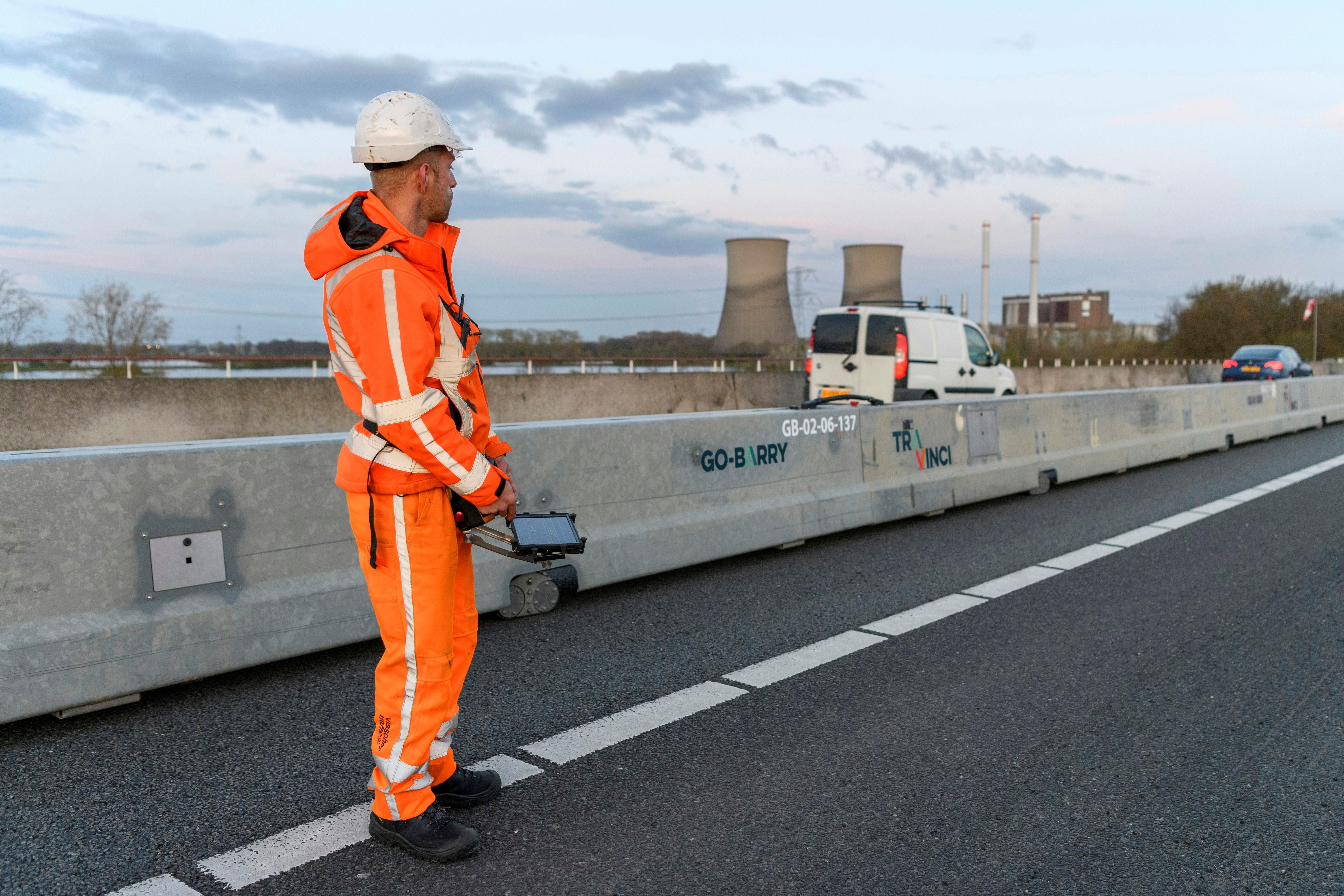
Innovative solutions such as mobile barriers, including the so-called Go-Barry, also contribute to this approach. These systems replace traditional roadwork barriers and offer employees better protection from passing traffic.
Rijkswaterstaat is also encouraging the electrification of construction equipment. This not only reduces CO₂ emissions, but also improves employee health by reducing exposure to diesel exhaust fumes.
Safety does not stop at the construction fence
According to Bagchus, safe working also means taking the surrounding area into account.
"Closing a motorway has major consequences for logistics, hospitals, businesses and emergency services. These discussions therefore need to take place much earlier, giving all parties enough time to adjust their logistical operations.”
She gives the example of hospitals being able to adapt their staffing schedules when they are informed well in advance about upcoming road closures. In this way, safety is improved not only on the construction site, but throughout the surrounding area.
"You want to avoid solving a safety problem in one place only to create another problem somewhere else.”
Rijkswaterstaat continues to learn
Although Rijkswaterstaat is often regarded as a leader within the infrastructure sector, the organisation actively looks beyond its own industry. According to Van Opzeeland, the petrochemical industry in particular offers valuable lessons.
"They have been at the forefront of safety management, contractor management and safety culture for much longer. There is certainly a great deal we can learn from them.”
Approaches such as Heart & Minds have already been partially adopted. Rijkswaterstaat also sees similarities between maintenance shutdowns at refineries and large-scale infrastructure projects in which roads or locks are temporarily taken out of service.
From client to partner
Perhaps the most important change is the relationship between Rijkswaterstaat and the market. According to Bagchus, safety is becoming less about prescribing rules and carrying out inspections, and increasingly about working together.
"It is about having the right conversation and exploring together how something can be done safely. In my view, that has been the most important development in recent years.”
This collaboration is more important than ever, particularly now that maintenance is being postponed, budgets are under pressure and infrastructure continues to age.
During Safety&Health@Work, Nienke Bagchus will explain how Rijkswaterstaat is putting this transition into practice. Not only through rules and procedures, but through an integrated safety approach in which clients, contractors and infrastructure managers jointly take responsibility for safe infrastructure and a safe working environment.
Register free of charge to attend Safety&Health@Work and join the session on Thursday, 8 October, from 12:45 to 13:30. View the full programme here.