

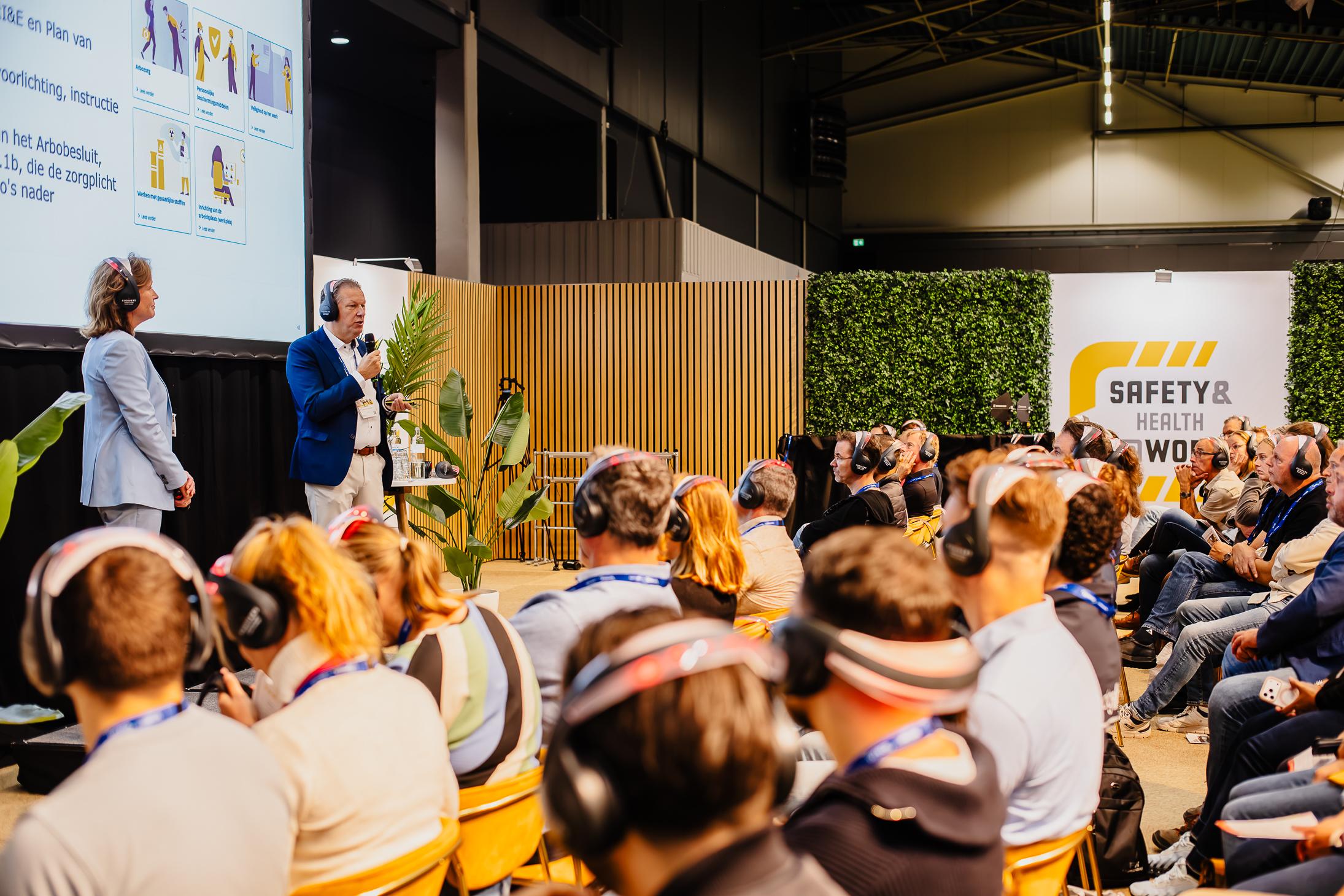
From a serious workplace accident that changed a life forever to smart clothing designed to help prevent accidents. The second day of Safety&Health@Work at Rotterdam Ahoy showed just how broad the issue of safety has become. Rijkswaterstaat is facing the largest maintenance challenge in its history and is looking for ways to embed safety more firmly into its operations. At the same time, new technologies are emerging that can detect risks before something goes wrong. Yet one message echoed throughout the various presentations: ultimately, safety begins with people who listen to one another, speak up and take responsibility.
One accident, lifelong consequences
Sometimes a personal story says more than a thousand safety protocols. Johan Tins knows that better than anyone. During his presentation Learning from Workplace Accidents: From Incident to Insight, he took the audience back to the glass factory where he worked as a maintenance technician. A familiar workplace, familiar colleagues, daily routines. Until a machine was unexpectedly released and everything changed.
Tins was seriously injured. Tendons, an artery and nerves in his right hand were damaged. After months of rehabilitation, he received the devastating news that he would never be able to return to the profession he loved. "Your hand is your tool as a technician. And I was a technician through and through.”
But the physical damage turned out to be only part of the story. Tins spoke openly about the psychological consequences, the difficult return to work and an insurance dispute that would last ten years. He was eventually diagnosed with PTSD. The accident affected his family, his marriage and his trust in the organisation he had worked for.
His account of returning to the factory for the first time was particularly telling. After three months in a rehabilitation centre, he was invited to have coffee with colleagues. When he entered, he saw a safety poster. To him, its message felt like an accusation that he himself had not been careful enough. "I was incredibly angry. I was sad.” His colleagues noticed nothing. He put on a poker face and drank his coffee.
It illustrates how wide the gap can be between the intention behind safety communication and the way it is experienced on the work floor.
Would you let your own child work here?
Tins, who is now involved with Stichting Arbeidsongevallen, argued that after an incident, organisations should look beyond the individual mistake. Which safety barriers should have prevented the accident? Why did they fail? And who truly felt responsible? His definition of safety is strikingly simple: "Taking care of each other, listening to each other, looking out for each other, speaking to each other and reporting together.”
And for anyone who still finds that too abstract, he has an equally simple but confronting test: "How would you feel if your own child were working on this site? Would you let them do an internship here, yes or no?”
The biggest maintenance operation ever
From the human consequences of one accident to a safety challenge of national scale. Nienke Bagchus, Director of Safety at Rijkswaterstaat, and Anton van Opzeeland, Strategic Safety Advisor, outlined the enormous task facing their organisation.
Rijkswaterstaat manages more than 5,400 kilometres of national roads, 1,143 bridges, 27 tunnels and approximately 6,300 kilometres of waterways. A significant share of this infrastructure dates from the 1950s, 1960s and 1970s and is approaching the end of its technical lifespan. The Netherlands is therefore facing what Rijkswaterstaat itself calls its largest maintenance challenge ever.
That maintenance has to take place while the country continues to function as usual. Trucks must keep moving, ambulances must still be able to reach hospitals and ships must reach their destinations. At the same time, thousands of employees working for contractors and subcontractors must be able to carry out their work safely.
A practical example showed just how complex this can be. On one bridge, insufficient reinforcement was discovered in the concrete. The first instinct was logical: ban heavy freight traffic. But that could shift the safety risk to roads through residential areas, where suddenly many more trucks would pass cyclists and schoolchildren. A technical issue can therefore quickly become a broader societal safety problem.
According to Bagchus and Van Opzeeland, this requires a broader approach to safety. Rijkswaterstaat has several responsibilities: as an infrastructure manager, as an employer and as a client. The organisation is therefore placing increasing emphasis on safety in design, procurement and execution.
Safety cannot simply be ticked off
Rijkswaterstaat is working on a renewed structure for its safety organisation, with cooperation with contractors playing a central role. The Safety Culture Ladder is an important part of this. Since July 2023, contractors involved in projects have been subject to safety culture requirements. But a certificate on the wall is no guarantee of a safe construction site.
The presentation highlighted that risk assessments and safety plans still too often contain outdated information or copied text. The documents may formally exist, while the actual risks are insufficiently understood. The tension between planning and safety was also discussed. Rijkswaterstaat has reviewed contracts for clauses and penalties that could unintentionally encourage unsafe behaviour. After all, if a contractor is put under severe time pressure, the effect on the people carrying out the work must also be considered.
Another challenge is the increasingly international workforce on construction sites. Long chains of subcontractors, language differences and varying safety cultures make clear communication more difficult. That creates an important responsibility for both clients and contractors: ensuring that everyone understands the risks and feels free to raise concerns about unsafe situations.
In that sense, Rijkswaterstaat’s message closely echoed Tins’ earlier story: safety only emerges when procedures, organisations and day-to-day practice are genuinely connected.
From protection to prediction
And then there is technology. While Tins showed what happens when safety barriers fail and Rijkswaterstaat focused on organising those barriers effectively, Guus de Hoog, Creative Director at Elitac Wearables, demonstrated how smart technology can help identify risks earlier.
His presentation offered a fascinating glimpse into the world of wearables: smart clothing, sensors, exoskeletons and wearable electronics that are increasingly finding their way into industry, construction, logistics and defence.
But De Hoog began with a warning. Anyone who thinks a smartwatch can already tell them everything about their health is overestimating the technology. Measuring heart rate and steps works reasonably well under certain conditions. Reliably measuring stress, sleep quality and other complex physiological processes is considerably more difficult.
Specialised wearables can do much more. Examples include sensors that detect hazardous gases, systems that warn employees about approaching vehicles and wristbands that detect heat stress. Exoskeletons can reduce the physical strain of heavy work, while smart cooling vests help employees who have to perform in high temperatures.
Ergonomics and mental strain were also discussed. Sensors can analyse movements in detail, for example to prevent incorrect lifting. Other applications can identify stress patterns and recovery moments.
And what about gloves that allow employees in virtual reality to actually feel how heavy, hard or large an object is? This makes it possible to practise high-risk tasks without shutting down a production line or exposing workers to danger.
Smart technology, difficult questions
According to De Hoog, the next step is to combine sensor data with artificial intelligence. AI can identify patterns that are barely visible to humans and use them to generate warnings or advice.
Edge AI in particular offers promising opportunities because data are processed directly on the wearable itself.
"The data no longer need to go to the cloud first,” he explained. This makes systems faster and reduces the need to process sensitive information externally.
However, technological development is only one side of the story. Who owns all the data collected by these devices? And how voluntary is consent to monitoring when the employer is also the person paying the salary?
De Hoog stressed that trust, privacy and clear benefits for the user are crucial. A wearable that primarily feels like a digital surveillance tool is unlikely to generate much enthusiasm. A device that demonstrably makes work safer, healthier or less physically demanding has a much greater chance of being accepted.
People remain the most important safety measure
This revealed an interesting contrast on the second day of the event. The possibilities for measuring, analysing and even predicting risks are becoming increasingly sophisticated.
At the same time, many safety problems can still be traced back to issues we have known about for years: miscommunication, routine behaviour, poor preparation, production pressure and insufficient attention to signals from the work floor.
Technology is becoming smarter. Infrastructure is becoming more complex. Safety organisations are becoming more professional. But all of that has little value if nobody dares to say that something is unsafe.
Or, to return to the question Johan Tins used to challenge his audience: would you let your own child work here?