Cameras that detect fall hazards, sensors that warn of physical overexertion, and software that checks whether scaffolding has been assembled correctly. New technology can make construction sites safer. But according to AI specialist Arjan Walinga of Bouwend Nederland, successful innovation does not start with technology. "First, you need to determine what you want to achieve with it and how you are going to involve your employees.”
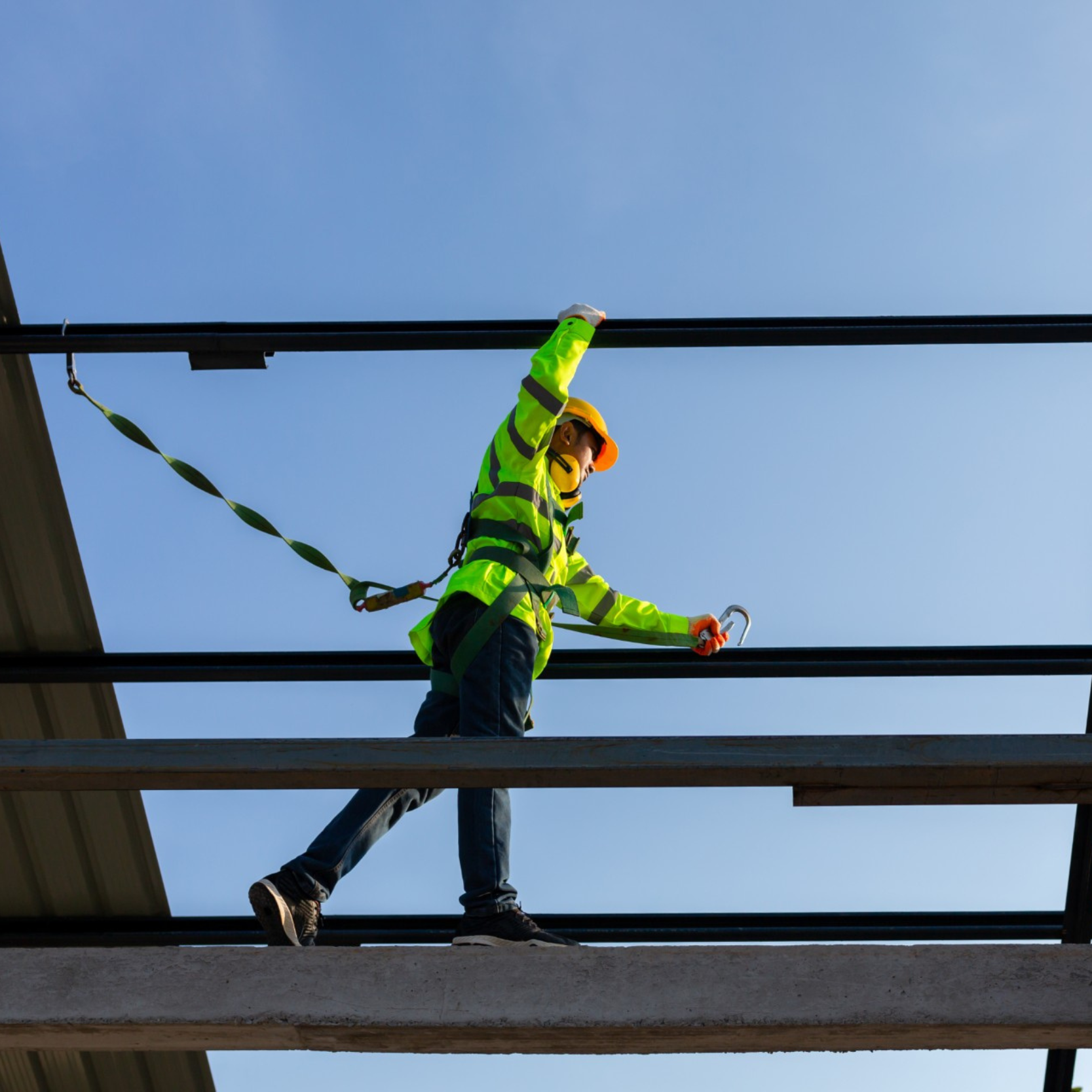
An employee moves unsecured close to the edge of a floor. Someone walks across the construction site without the required personal protective equipment. Smoke develops, or a worker enters the operating range of a rotating crane. Smart camera software is becoming increasingly accurate at recognising situations like these and can automatically issue a warning.
It is one of the developments that Arjan Walinga closely follows on behalf of Bouwend Nederland. At Safety&Health@Work, he will demonstrate how innovation and safe working practices can go hand in hand, while also addressing the dilemmas that arise. "The technical possibilities are developing rapidly,” Walinga says. "But what is technically possible is not always accepted. It is not always affordable either, and it is certainly not automatically the right thing to do.”
Catching up
The construction sector has long lagged behind industries such as petrochemicals when it comes to safety, Walinga acknowledges. In those sectors, safety has been a strict prerequisite for being allowed to work for many years. Today, however, he also sees a clear shift among construction companies.
"The aim is zero fatalities. Construction companies do not say that simply because it sounds good. Especially in smaller businesses, the owner knows the employees and often their families as well. A serious accident has an enormous impact in such an environment.”
For that reason, safety is always the first item on the agenda in Bouwend Nederland meetings. Business owners share safety plans, but they also discuss near misses.
"That requires people to be vulnerable. Yet it is happening more and more often. Awareness is growing, although compared with other industries, we still have some catching up to do.”
Detection
AI is currently used in the construction sector mainly for text, tenders, planning, and project administration. On the physical construction site, Walinga sees particular opportunities for computer vision: software that analyses camera footage and recognises patterns or anomalies.
Many construction sites already have CCTV cameras. By connecting smart software to these systems, footage can be assessed live or analysed afterwards. The system can detect hazards including fall risks, missing personal protective equipment, smoke development, and unsafe movements involving machinery.
Two major Dutch construction companies are currently experimenting with this type of software. Bouwend Nederland also wants to test the technology with smaller companies.
"A large construction company has the cameras, the people, and a construction site where a pilot like this can be carried out relatively easily. But an innovation only really adds value to the sector if it is also scalable and affordable for SMEs.”
Reliability is crucial. A system that repeatedly triggers false alarms will quickly lose credibility.
"If a system sounds an alarm four times and three of those alerts are incorrect, people will stop listening the fifth time. Detection therefore needs to be accurate enough to genuinely add value.”
Physical strain
Not all safety innovations revolve around camera surveillance. Walinga also points to wearable sensors that can measure physical strain.
A sensor belt can record how often and in what way someone lifts objects and can provide immediate feedback if necessary.
"You can warn someone that they are lifting something that is too heavy or that they are lifting incorrectly. But you can also use the data to provide employees with individual guidance or, at organisational level, to identify tasks that are structurally too physically demanding.”
Another application involves helmets equipped with 360-degree cameras and LiDAR technology. As employees walk around the construction site, the system maps the situation as it has actually been built. By comparing that information with the digital design, it can, for example, check whether scaffolding has been assembled correctly.
"In that case, you are not using imaging technology to track people, but to identify that something deviates from the plan and needs to be inspected.”
Privacy
This immediately brings Walinga to the most sensitive part of the discussion. A camera that detects unsafe situations will inevitably also record employees.
"If there were a camera constantly watching me from behind my laptop, I would feel uncomfortable too. On a public road, you can sometimes choose not to enter an area under camera surveillance. At work, you do not necessarily have that choice.”
That is why privacy should not only be discussed once a system has already been installed. Employees need to know in advance why footage is being collected, what will happen to it, how long it will be stored, and who can access it. Individuals can also be blurred so that the focus remains on the hazardous situation rather than on the employee.
"You have to be transparent. One hundred per cent certainty does not exist in the digital world. But you can organise things as securely as possible. After that, you make a joint assessment between privacy and preventing a serious accident.”
Walinga therefore advocates an approach based on ethics guidance: employees, technology suppliers, and employers jointly examine how an innovation can be introduced responsibly.
A pragmatic approach
Walinga is sceptical about spectacular robots taking over entire construction sites in the near future. Construction requires precision and involves constantly changing conditions.
For example, a machine operator can feel through the controls when an excavator bucket hits a pipe or a piece of steel. An autonomous machine is still barely capable of replicating that kind of feedback.
"I do not take futurists who claim they can predict the future very seriously. I prefer to look zero to three years ahead. Which technologies already exist, are affordable, and can be applied in construction tomorrow? That is often where the quickest improvements can be found.”
His main message at Safety&Health@Work is therefore that innovation should never be treated purely as a technical challenge.
"Do not start by asking what a system is capable of. First ask which safety problem you want to solve. Then discuss with the people on the construction site what would be a sensible, affordable, and acceptable application. Only then will innovation truly contribute to safer working conditions.”