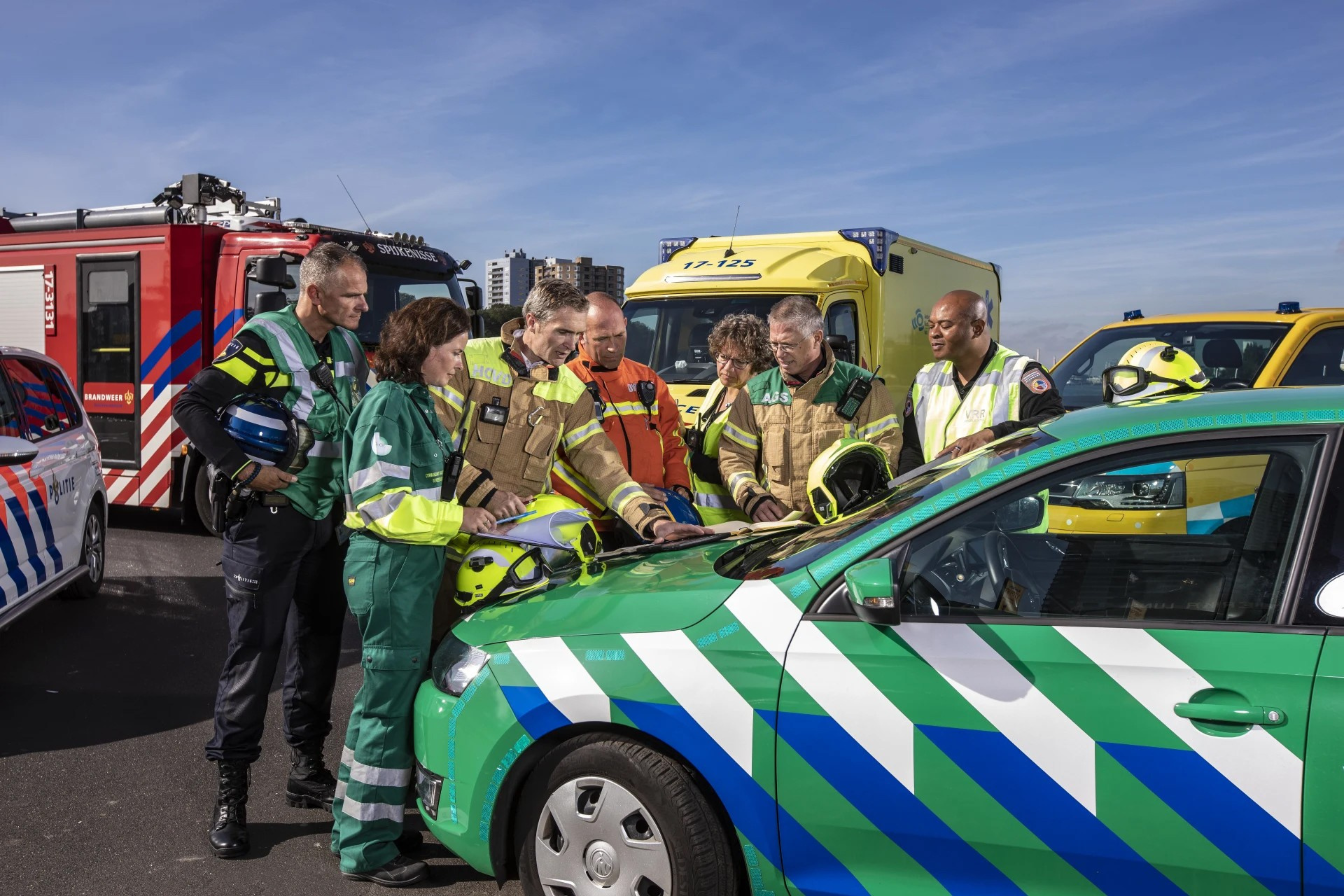
Crises are lasting longer, having a deeper impact and increasingly triggering chain reactions. Companies therefore need to know not only how to respond to an incident, but above all how to keep their most important processes running. "Don’t just think about the first hour, but about the situation after twelve or twenty-four hours,” says Edith van der Reijden, Director of Risk and Crisis Management at the Rotterdam-Rijnmond Safety Region.
According to Van der Reijden, the Netherlands has not necessarily become less safe. Society has, however, become much more vulnerable. This is mainly because organisations and residents have become highly dependent on electricity, mobile communications and digital systems.
A recent power outage in Rotterdam-Zuid made that vulnerability clearly visible. Around 20,000 households were left without electricity. Mobile communications failed, bridges could not be operated and residents of high-rise apartment buildings ran into problems because the lifts were not working.
"In the past, we had a major fire or an incident that lasted a few hours. Then it was over. Today, one disruption can affect all kinds of other processes. If your phone stops working, you often can’t pay, communicate or operate systems either.”
Accumulating risks
That dependence on technology coincides with other developments. In addition to flood risks, climate change brings prolonged drought and possible shortages of drinking water. Cyberattacks pose a constant threat, while geopolitical tensions can affect energy, fuel and raw materials.
"It is not a question of whether you will be hacked, but when,” says Van der Reijden. "Companies and residents need to prepare themselves better for that.”
Many risks converge in Rotterdam-Rijnmond in particular. The region combines a densely populated urban environment with port activities, the chemical industry, vulnerable infrastructure and major logistics flows. As a result, a disruption can quickly affect a large area and multiple sectors.
Continuity
For companies, resilience mainly means taking a critical look at business continuity, according to Van der Reijden. Which processes must continue under all circumstances? Which activities can temporarily be shut down? And can that be done safely?
This is not only about technology. An organisation may have backup power and redundant systems, but without employees many processes will still come to a standstill.
"Companies can only operate if people are available. But those employees are residents too. During a prolonged power outage, they may need to stay home to care for children or vulnerable parents. So the question is also: during a crisis, can you still rely on your staff, and can you even reach them?”
The Netherlands is also organised as a just-in-time economy. Companies keep relatively small inventories, while consumers are used to products being available quickly. During prolonged disruptions, supplies of food, drinking water, medicines and other essential goods can therefore run out quickly.
The government is therefore asking citizens, businesses and institutions to be as self-reliant as possible during the first 72 hours. According to Van der Reijden, sectors including banking and food retail are already working intensively on these continuity issues.
The chain
A common mistake is for organisations to focus on a single technical solution. A backup generator, for example, may seem sufficient to deal with a power outage. In practice, however, systems often depend on other connections.
"A pump may have backup power, but if its controls run through a 4G or 5G network and that network goes down, the pump still won’t work. You therefore need to understand the entire chain. Can a system also be operated manually? And does anyone know how to do that?”
According to Van der Reijden, exercises are essential for revealing these dependencies. Organisations also need to look beyond the start of an incident.
"You can practise what happens immediately after the power goes out. But it is more interesting to ask: where are we twelve or twenty-four hours later? Are the diesel tanks for the backup generators still full? Are employees still available? Do communication systems still work? That creates very different dilemmas.”
Accessibility
Planned infrastructure works can also put the resilience of companies to the test. In the coming years, major works will take place around Rotterdam on bridges, tunnels and motorways. This will affect not only the accessibility of emergency services, but also commuting and logistics chains.
Special arrangements are made for fire brigades and ambulances during major closures. Companies do not have the same exemptions.
"For logistics companies, disruptions like these can be very costly. Resilience therefore also means thinking in advance about alternative routes, different working hours, inventories and staff availability.”
Making preparedness normal
Van der Reijden believes the Netherlands will become more resilient when it becomes normal for organisations to talk about possible disruptions. Not out of fear, but out of realism.
"It should be perfectly normal to discuss over coffee what you would do during a power outage, a digital outage or a fuel shortage. Do we have an emergency plan? Are the power banks charged? Do we know which processes need to continue?”
At the same time, she warns against taking an overly individualistic approach. Not everyone has the same financial resources, a well-stocked pantry or a strong social network.
"It is not just about self-reliance, but about collective resilience. Look out for colleagues, neighbours and vulnerable family members too. Resilience means being prepared and looking after one another.”
During Safety&Health@Work at Rotterdam Ahoy, Van der Reijden will explain how organisations can make the transition from incident response to structural resilience. Her key message: do not wait until a crisis reveals what your organisation depends on. "You don’t have to be afraid. But it is wise to think in advance about what you will do if the services you normally take for granted suddenly disappear.”